For companies that organise several events each year, the challenge is not only delivering one successful reception. It is making the next one feel different — without making the planning process more complicated.
The first successful event is only the beginning.
For repeat corporate clients, a catering partner gradually learns how the company works: the expected service level, the venue, building procedures, guest profiles, dietary requirements, preferred timings and the small operational details that make an event run smoothly.
That familiarity is valuable.
But many of the guests may also be familiar.
Local teams attend several company events during the year. Executives return to Tokyo. Colleagues visit from overseas offices. Clients and partners may be invited to multiple receptions.
So the real question becomes:
How do you keep the reliability of a trusted catering partner while making every guest experience feel new?
At Tokyo Catering Club, we believe this is one of the most important aspects of long-term corporate catering in Tokyo.
The relationship should become easier for the client every time.
The experience should not become predictable for the guest.
Reliability should repeat. The guest experience should not.
In This Article
- Why flexibility matters for repeat corporate events
- A recent live catering experience at Porsche Center Takanawa
- How live sushi, ramen, yakitori, wagyu, matcha and cocktails change an event
- Why an office can sometimes be a better venue than a restaurant for groups of 50+
- How international teams can experience Japan without leaving the workplace
- Why flexibility requires stronger operations, not improvisation
- Frequently asked questions about flexible corporate catering in Tokyo
Consistency Does Not Have to Mean Repetition
There are clear advantages to working repeatedly with the same catering partner.
The team already understands the client. Venue access becomes familiar. Communication is faster. Operational risks are easier to anticipate. Previous feedback can immediately be incorporated into the next event.
All of this should create consistency.
But consistency should apply primarily to the things guests should never have to worry about:
- timing;
- food quality;
- hygiene and food safety;
- staffing;
- dietary management;
- venue coordination;
- presentation standards;
- logistics;
- and clear communication.
The creative experience can — and often should — change.
One event may be a refined cocktail reception.
The next may feature a sushi counter.
Another may become an izakaya-style evening with live yakitori.
A daytime event might use live matcha, specialty coffee or French pastries.
A larger celebration might revolve around wagyu carving, bartending and multiple food stations.
For us, flexibility means understanding what should remain consistent and what should evolve.
This philosophy is closely connected to the way we approach hospitality more broadly: food, service and operations should be designed around the client, the audience and the environment rather than forcing every event into one standard catering format. You can read more about this approach in How Tokyo Catering Club Operates Where Traditional Catering Cannot.
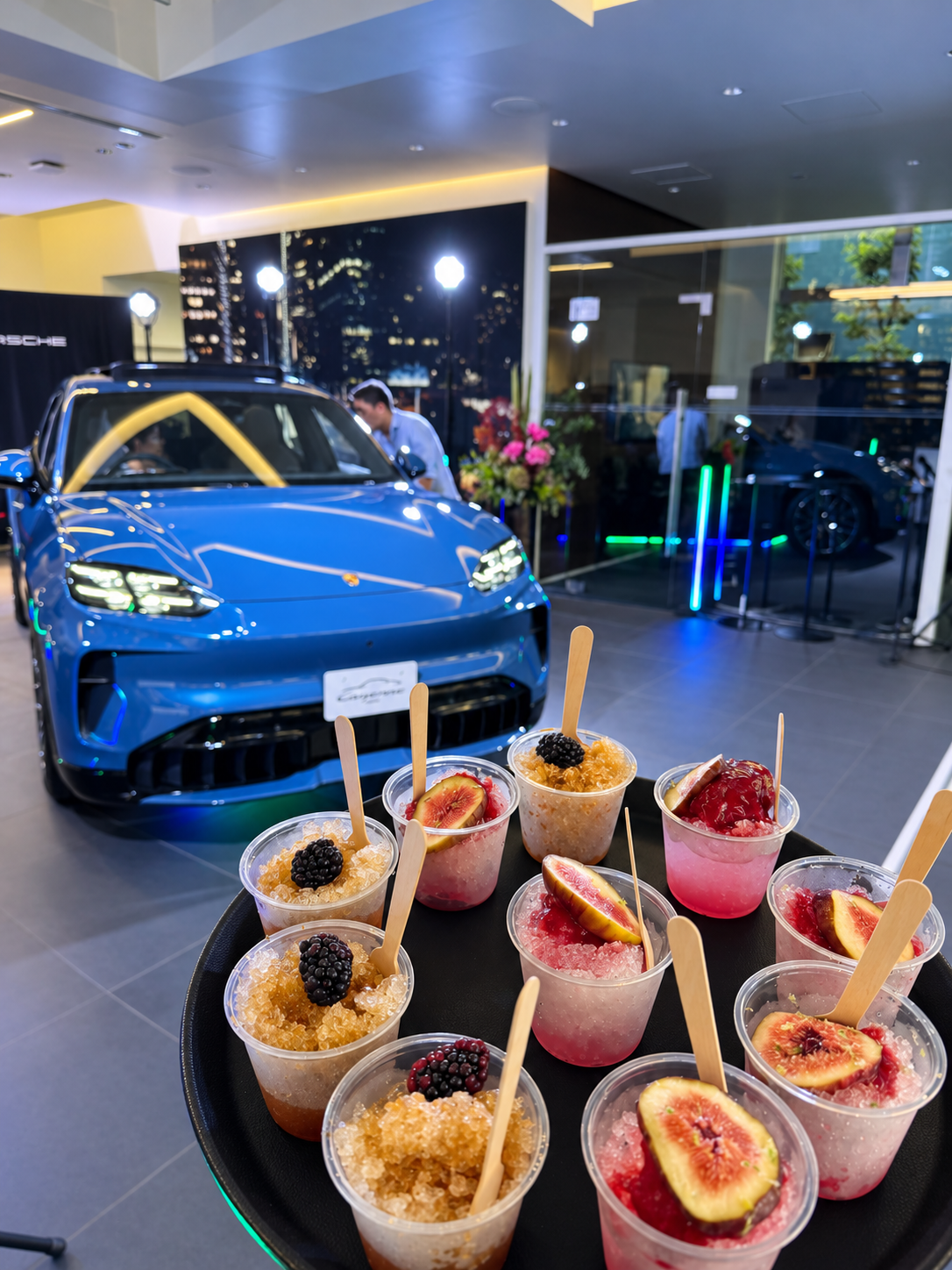
Case Study: A French-Japanese Afternoon Experience at Porsche Center Takanawa
A recent event at Porsche Center Takanawa is a good example.
The event took place around the presentation of the new Cayenne Electric and welcomed guests across two afternoon sessions.
Rather than creating a conventional cocktail buffet, we developed the catering around a more relaxed, premium goûter-style experience.
The centre of the concept was simple:
- fresh crêpes prepared live in front of guests;
- Japanese kakigori;
- a light non-alcoholic beverage selection;
- and a presentation adapted to the showroom and the event’s visual identity.
The combination was intentionally Franco-Japanese.
The crêpes brought warmth, aroma and a familiar French reference.
The kakigori introduced a completely different seasonal Japanese element: fresh, visual and playful without losing the premium character of the event.
More importantly, both formats created interaction.
Guests were not simply taking food from a static buffet. They could watch preparation, approach the stations, interact with the team, choose what they wanted and return later during the session.
The catering became part of the event rather than simply something placed beside it.
The beverage programme followed the same principle. Because this was an afternoon format, the drinks remained light and refreshing instead of unnecessarily turning the experience into an evening-style bar service.
The response from both the client and guests was very positive.
And it demonstrated something we see repeatedly:
A memorable catering experience does not need to be complicated. It needs to feel right for the occasion.
For automotive, luxury and brand environments, this distinction matters. Hospitality should support the wider event identity rather than compete with it.
You can explore other examples of our corporate and brand work in the Tokyo Catering Club portfolio and our Media & Publications section.
The Repeat-Guest Challenge in Corporate Hospitality
Some of the most interesting briefs we receive do not come from first-time clients.
They come from companies we already know.
A corporate client might organise an executive visit in January, an internal reception in spring, a regional meeting during summer and another international gathering before the end of the year.
The organiser may remain the same.
The venue may remain the same.
And many of the people attending may also remain the same.
Changing two canapés on a buffet is not enough to make those events feel genuinely different.
Once the operational relationship is established, the conversation can move from:
“Can you cater our event?”
to a much more interesting question:
“What could we do differently this time?”
Live Catering Can Completely Change the Atmosphere
Over time, Tokyo Catering Club has developed a wide range of interactive formats for repeat corporate clients, international teams, brand events and VIP hospitality.
These have included:
- live sushi;
- live ramen;
- live yakitori;
- wagyu carving;
- made-to-order wagyu burgers;
- live matcha preparation;
- bartending and signature cocktails;
- crêpes;
- kakigori;
- matsuri-style catering;
- izakaya-inspired office receptions;
- and even live Mexican tacos developed with a Japanese twist.
The objective is not simply to accumulate more “stations”.
Each format creates a different social dynamic.
Live Sushi
A sushi counter brings precision, craftsmanship and interaction.
Guests often approach in smaller groups, observe the chef and experience a culinary format strongly associated with Japan. For international visitors, it can provide a meaningful Japanese experience without requiring a separate restaurant reservation.
Live Ramen
Ramen creates a completely different atmosphere.
It is warmer, more informal and immediate. Bowls finished during the event can work particularly well for visiting international teams who want something unmistakably connected to Tokyo while remaining inside a corporate environment.
Live Yakitori
Yakitori introduces grilling, aroma, movement and a familiar izakaya reference.
Executed properly, it can transform a conventional corporate space into something much more social and atmospheric.
Wagyu Carving
For premium receptions, live wagyu carving creates a focal point within the room.
The ingredient itself becomes part of the hospitality programme and the preparation adds a sense of occasion without requiring formal seated dining.
Live Wagyu Burgers
The same ingredient can also be interpreted in a completely different way.
Freshly prepared wagyu burgers produce a more relaxed, generous and social experience while maintaining a strong Japanese identity.
Live Matcha
Matcha provides a quieter form of interaction.
It can work particularly well for daytime hospitality, international management programmes and visitors interested in Japanese culture, especially when incorporated into a wider tea, coffee or dessert experience.
Bartending and Signature Cocktails
A professional cocktail station can become part of the programme itself.
Drinks can be developed around a season, ingredient, brand identity or event theme rather than simply offering a standard bar.
Mexican Tacos with a Japanese Twist
Flexibility also means not forcing an event into a simple choice between “Japanese” and “Western” cuisine.
We have created live Mexican taco concepts where fillings, sauces and seasonings were reinterpreted using Japanese ingredients and flavours.
The format kept the energy and informality of a taco bar while making the recipes relevant to the event and its location in Tokyo.
Sometimes the most interesting hospitality ideas exist between culinary cultures rather than inside only one of them.
Why Live Catering Works Particularly Well for International Teams in Tokyo
International companies regularly bring teams, executives and partners from Europe, North America and other parts of Asia to Japan.
These visitors naturally want to experience Tokyo.
But their schedules are often built around work.
Meetings finish late. Conference programmes are full. And the group may include 50, 80 or 150 people.
Taking everyone to a restaurant can quickly become complicated.
With the right catering setup, the experience can instead come to them.
A meeting may finish at 18:00.
Fifteen minutes later, an adjacent event space can feature:
- a sushi counter;
- ramen being finished to order;
- live yakitori;
- a wagyu station;
- matcha preparation;
- Japanese-inspired cocktails;
- or several concepts operating simultaneously.
No taxis need to be organised for 70 people.
The group remains together.
The evening can begin immediately.
And international guests can still experience something distinctly connected to Japan.
For overseas organisers, this is particularly valuable. Our article Planning a Corporate Event in Japan: What International Teams Need to Know explains some of the wider operational considerations involved in producing events in Japan.
For Groups of 50 or More, the Office Can Sometimes Be Better Than a Restaurant
Tokyo has exceptional restaurants.
For a dinner of eight or twelve people, they are often the obvious solution.
For fifty, seventy or one hundred guests, the situation changes.
A suitable restaurant must combine capacity, privacy, location, dietary flexibility, availability, atmosphere and the ability to accommodate the event programme.
Large groups may be divided between several tables. Networking becomes more difficult. Speeches may interrupt service. Transport adds another layer of logistics.
Sometimes the most practical event venue is already available:
- a company event floor;
- a meeting room;
- a corporate lounge;
- a showroom;
- a terrace;
- a gallery;
- or a dedicated space adjacent to the office.
Instead of transporting seventy people to an izakaya, the izakaya atmosphere can be brought to them.
Instead of reserving an entire sushi restaurant, a sushi chef can operate inside the event.
Instead of taking a team somewhere else for ramen, ramen can become one chapter of the evening.
A boardroom can become a cocktail lounge.
A corporate event floor can become a matsuri.
A showroom can become a French-Japanese afternoon café.
The venue stays familiar. The experience changes.
This is one of the ideas explored further in our article on transforming corporate spaces into temporary hospitality environments.
For companies considering external venues instead, our guide to corporate and luxury event venues in Tokyo explains why access, infrastructure and venue familiarity matter so much in this city.
Bringing the Experience to the Guest
There is an important shift behind this approach.
Traditional corporate hospitality often means taking guests somewhere.
A restaurant.
A hotel.
A bar.
A private dining room.
Professional catering can reverse that relationship.
The experience comes to the guests.
This gives an organiser much greater control over timing, branding, guest flow and atmosphere.
The reception can begin immediately after a conference.
A speech can happen without stopping restaurant service.
Food can appear progressively.
A live station can open halfway through the evening.
A welcome Champagne service can later transition into cocktails.
Dessert can be introduced after the main programme rather than sitting on the buffet from the beginning.
The evening develops in chapters.
That progression is particularly useful for longer events because it prevents the hospitality from feeling static.
Flexibility Is Not Improvisation
There is an important distinction.
A flexible caterer is not simply a caterer willing to say yes to everything.
Professional flexibility depends on operational control.
A live ramen station has different requirements from sushi.
Yakitori introduces heat, ventilation and smoke considerations.
Wagyu carving requires appropriate holding temperatures, carving space and guest flow.
A cocktail bar requires ice management, cold storage, glassware, preparation space and sufficient bartending capacity.
Sushi requires rigorous temperature control and a service rhythm capable of matching demand.
Matcha operates at a completely different pace.
The visible experience may feel effortless.
Behind it should be carefully planned.
Tokyo venues can also involve:
- restricted loading times;
- freight elevator reservations;
- security registration;
- floor protection;
- electrical limitations;
- fire and heat restrictions;
- temporary back-of-house requirements;
- and strict setup and breakdown windows.
This is why we consider flexibility an operational capability, not only a creative one.
The strongest concept is the one that sits at the intersection of:
what the client wants, what the guest will enjoy, and what the venue can support properly.
For more on this operational approach, see Why Event Hospitality in Japan Is Mostly an Operations Problem.
Flexibility Matters at Every Scale
This principle is not limited to intimate receptions.
It becomes even more important as events grow.
Multiple guest profiles may require different food concepts running at the same time. Different areas may need different service rhythms. Dietary requirements need to be integrated without creating a visibly separate experience.
At large scale, menu variety becomes part of guest-flow planning.
Tokyo Catering Club regularly works across formats ranging from executive meetings and office hospitality to complex high-capacity events. Our large-scale event catering page and the case study Corporate Catering in Tokyo at Scale explore this side of the operation in more detail.
The Value of a Long-Term Catering Partner
The first event requires discovery.
The caterer learns the company.
The company learns the caterer.
The venue is understood.
Operational constraints are identified.
Preferences become clearer.
By the third, fourth or fifth event, that accumulated knowledge becomes extremely valuable.
The caterer may already know:
- where deliveries enter;
- which elevator is used;
- where temporary back-of-house can be installed;
- how much setup time is realistically available;
- which dietary restrictions recur;
- how formal the service needs to feel;
- what worked especially well last time;
- and what should be different next time.
This should make every future event easier to organise.
But that efficiency should create more room for creativity, not less.
Behind the scenes, the event becomes increasingly familiar.
In front of the guest, it should continue to feel fresh.
Frequently Asked Questions About Corporate Catering in Tokyo
Can a caterer create a different concept for every repeat corporate event?
Yes. The same catering partner can change the cuisine, drinks, live stations, presentation style and service rhythm while maintaining consistent operational standards. The best concept depends on the guests, venue, schedule and objectives of each event.
What live food stations work well for corporate events in Tokyo?
Depending on the venue, options can include sushi, ramen, yakitori, wagyu carving, wagyu burgers, crêpes, kakigori, matcha, tacos, dessert stations and professional cocktail bars. The appropriate choice depends on guest count, space, cooking restrictions and desired atmosphere.
Can Tokyo Catering Club cater directly inside an office?
Yes. Office catering can range from simple delivery to fully staffed hospitality programmes with buffets, bars and live food stations. Building access, temporary back-of-house, equipment and food-safety requirements are assessed according to the location.
Can an office event replace taking a large group to a restaurant?
For larger groups, it often can. An office or adjacent event room may offer more freedom for networking, speeches, branding, guest circulation and live culinary experiences while avoiding the transport and seating constraints associated with restaurants.
Can a corporate event be designed specifically for overseas visitors to Japan?
Yes. Japanese experiences such as sushi, ramen, yakitori, matcha and wagyu can be integrated into an international corporate event while remaining accessible to mixed guest profiles. Japanese and international culinary influences can also be combined when appropriate.
Does Tokyo Catering Club support both small corporate events and large-scale productions?
Yes. Tokyo Catering Club supports executive meetings, corporate receptions, multi-day hospitality programmes, brand activations and large-scale event operations in Tokyo and across Japan. Selected examples can be found in our corporate catering portfolio.
The Best Question a Repeat Client Can Ask
One of our favourite questions from a company we already work with is:
“What could we do differently this time?”
Sometimes the answer is sushi.
Sometimes ramen.
Sometimes yakitori.
Sometimes cocktails.
Sometimes a Japanese matsuri.
Sometimes French crêpes and Japanese kakigori.
And sometimes it is a Mexican taco station reinterpreted with Japanese flavours.
The concept matters.
But the thinking behind it matters more.
It should suit the guests.
It should suit the venue.
It should suit the purpose of the event.
And it should work operationally.
That is what flexibility in professional catering should mean.
Reliability for the Client. Discovery for the Guest.
Long-term corporate hospitality should not force companies to choose between reliability and creativity.
They should reinforce each other.
A trusted catering partner already understands how the client works.
That reduces uncertainty.
It simplifies operations.
And it creates more space to focus on the experience itself.
At Tokyo Catering Club, this is how we think about repeat corporate events.
Consistency in execution. Flexibility in experience.
Because the objective of the fifth event is not simply to reproduce the success of the first one.
It is to build on it.
For the client, the fifth event should feel easier than the first.
For the guest, it should still feel completely new.
For corporate receptions, office hospitality, international team programmes, live food stations and recurring events in Tokyo, explore our Corporate Catering services, browse our selected projects, or request a catering proposal.
日本語版|東京の法人ケータリングで「柔軟性」が重要な理由
年間を通じて複数の企業イベントを開催する場合、重要なのは一度だけ成功することではありません。同じクライアント、同じ会場、そして同じゲストが参加する中で、毎回新しい体験をつくることが求められます。
長期的に同じケータリング会社と仕事をすることには、大きなメリットがあります。
回数を重ねることで、ケータリングチームはクライアントの希望、会場の搬入方法、ビル管理、サービスレベル、ゲスト層、食事制限、タイムスケジュールなどを理解していきます。
運営はよりスムーズになります。
一方で、参加するゲストも同じ場合があります。
国内の社員が年間を通じて複数のイベントに参加したり、海外オフィスの経営層やスタッフが定期的に東京を訪れたりするケースでは、毎回同じビュッフェでは新鮮さが失われてしまいます。
Tokyo Catering Clubでは、長期的な法人イベントにおいて、次の考え方を大切にしています。
クライアントにとって運営はより簡単に。
ゲストにとって体験は常に新しく。
繰り返すべきなのは「品質」であり、「体験」ではない
毎回安定しているべきなのは、時間、品質、衛生管理、スタッフ、ロジスティクス、アレルギー対応、会場との調整、コミュニケーションです。
しかし、料理やサービススタイルまで同じである必要はありません。
イベントごとに、以下の要素を変えることができます。
- 料理のコンセプト
- ドリンク
- ライブステーション
- ビュッフェの見せ方
- サービスのタイミング
- ゲストとのインタラクション
- イベント全体の雰囲気
Porsche Center Takanawaでのフレンチ × ジャパニーズ体験
最近のPorsche Center Takanawaでのイベントでは、一般的なカクテルビュッフェではなく、午後のプレミアムな「goûter(フランス式のおやつ時間)」をイメージしたケータリングを構成しました。
中心となったのは、
- ゲストの目の前で焼き上げるクレープ
- 日本らしいかき氷
- 軽く爽やかなノンアルコールドリンク
でした。
フランスらしいクレープと、日本の季節感を感じさせるかき氷を組み合わせることで、シンプルながらも明確なテーマを持つ体験になりました。
料理を置くだけではなく、ゲストが調理を見て、スタッフと会話し、好きなタイミングでステーションに戻ることができます。
ケータリングそのものがイベントの一部になります。
クライアント、そしてゲストの双方から非常にポジティブな反応をいただきました。
印象に残る体験は、必ずしも複雑である必要はありません。そのイベントに自然に合っていることが重要です。
同じ企業でも、毎回違うライブ体験を
Tokyo Catering Clubでは、法人イベントや海外チーム向けのホスピタリティとして、さまざまなライブ形式を実施してきました。
- ライブ寿司
- ライブ・ラーメン
- ライブ焼き鳥
- 和牛カービング
- 和牛バーガー
- 抹茶ライブサービス
- バーテンダーによるカクテルステーション
- クレープ
- かき氷
- 夏祭りスタイル
- 居酒屋スタイル
- 日本の食材や味を取り入れたメキシカンタコス
重要なのは、単にメニューを増やすことではありません。
それぞれの形式によって、イベントの雰囲気そのものを変えることです。
寿司カウンターでは職人の技術を楽しむことができます。
ラーメンはよりカジュアルで温かい雰囲気をつくります。
焼き鳥は香りやライブ感を加えます。
和牛カービングはプレミアムなレセプションの中心になります。
同じ和牛でも、バーガーにすればよりリラックスしたイベントに変わります。
50名以上なら、レストランよりオフィスが適している場合も
東京には素晴らしいレストランが数多くあります。
しかし、50名、70名、100名以上になると、貸切、座席、移動、食事制限、スピーチ、ネットワーキングなどの条件が複雑になります。
その場合、企業内のイベントスペースや会議室、ラウンジ、ショールーム、テラスなどを利用する方が柔軟なケースがあります。
70名を居酒屋へ移動させるのではなく、居酒屋の体験をオフィスに持ってくる。
寿司店を貸し切るのではなく、寿司カウンターをイベント会場につくる。
海外から来日したチームをラーメン店へ移動させるのではなく、イベントの中でライブ・ラーメンを提供する。
会議終了後、そのまま隣のスペースで日本らしいホスピタリティを体験することができます。
移動も不要です。
チームも分かれません。
イベント全体の時間もコントロールできます。
柔軟性は「即興」ではない
プロフェッショナルな柔軟性には、しっかりとしたオペレーションが必要です。
ラーメン、寿司、焼き鳥、和牛、カクテル、抹茶では、それぞれ必要な設備、温度管理、電源、換気、スタッフ人数、提供スピードが異なります。
さらに東京のイベント会場では、
- 搬入時間
- 搬入口
- 業務用エレベーター
- セキュリティ登録
- 電源
- 火気
- 仮設キッチン
- 設営・撤去時間
などの条件もあります。
そのため、最も良いケータリングコンセプトとは、
クライアントが実現したいこと、ゲストが楽しめること、そして会場で安全かつスムーズに実行できること。
この3つが重なるポイントにあります。
長期的なケータリングパートナーの価値
最初のイベントでは、お互いを理解することから始まります。
しかし、3回目、4回目、5回目になると、その経験が大きな価値になります。
ケータリング会社はすでに、搬入口、エレベーター、設営時間、会場の特徴、クライアントのサービス基準、過去に好評だったものなどを理解しています。
そのため、イベントの準備はより簡単になります。
そして、その効率化によって、新しい体験を考えるための余裕が生まれます。
クライアントにとって、5回目のイベントは1回目より簡単に。
ゲストにとって、5回目のイベントも初めてのように新鮮に。
Tokyo Catering Clubは、東京での法人レセプション、オフィスイベント、海外チーム向けホスピタリティ、ライブフードステーション、複数日にわたる企業イベントをサポートしています。