From Ginza Boutiques to Temple Activations
In Tokyo, premium hospitality is rarely only about food.
For luxury brands, global corporations and embassies operating in Japan, the real challenge is often operational: creating refined guest experiences inside venues that were never designed for catering in the first place.
Luxury boutiques may have no kitchen. Automotive showrooms may have almost no backstage space. Temples may require extremely early setup and highly discreet operations. Corporate headquarters often impose strict security, timing and logistical constraints.
In many cases, hospitality teams are expected to deliver restaurant-level experiences while remaining almost entirely invisible operationally.
This is precisely where Tokyo Catering Club has progressively built its reputation.
Rather than functioning as a traditional caterer, the company increasingly operates as a hospitality partner for brands requiring custom food concepts, precise logistics and high-level execution inside some of Tokyo’s most demanding environments.
Today, Tokyo Catering Club supports projects ranging from luxury retail activations and diplomatic receptions to executive corporate hospitality, private gastronomic dinners and multi-day workplace experiences for international teams operating between Japan and overseas offices.
What connects these very different projects is always the same objective: creating hospitality that feels fully integrated into the client’s brand universe rather than simply added onto an event.
Rather than promoting one fixed culinary identity, Tokyo Catering Club approaches each project by building hospitality concepts around the client, the audience and the operational environment itself.
Depending on the event, this may involve refined French gastronomy, Japanese hospitality formats, premium corporate catering, live cooking experiences, luxury cocktail receptions or highly experiential food concepts developed specifically for the activation.
To support this flexibility, Tokyo Catering Club regularly collaborates with specialized chefs, culinary consultants, baristas and hospitality professionals capable of bringing expertise from different culinary worlds depending on the nature of the project.
For certain events, these specialists also operate live stations directly on site, allowing guests to experience restaurant-style hospitality inside environments where traditional dining operations would normally be impossible.
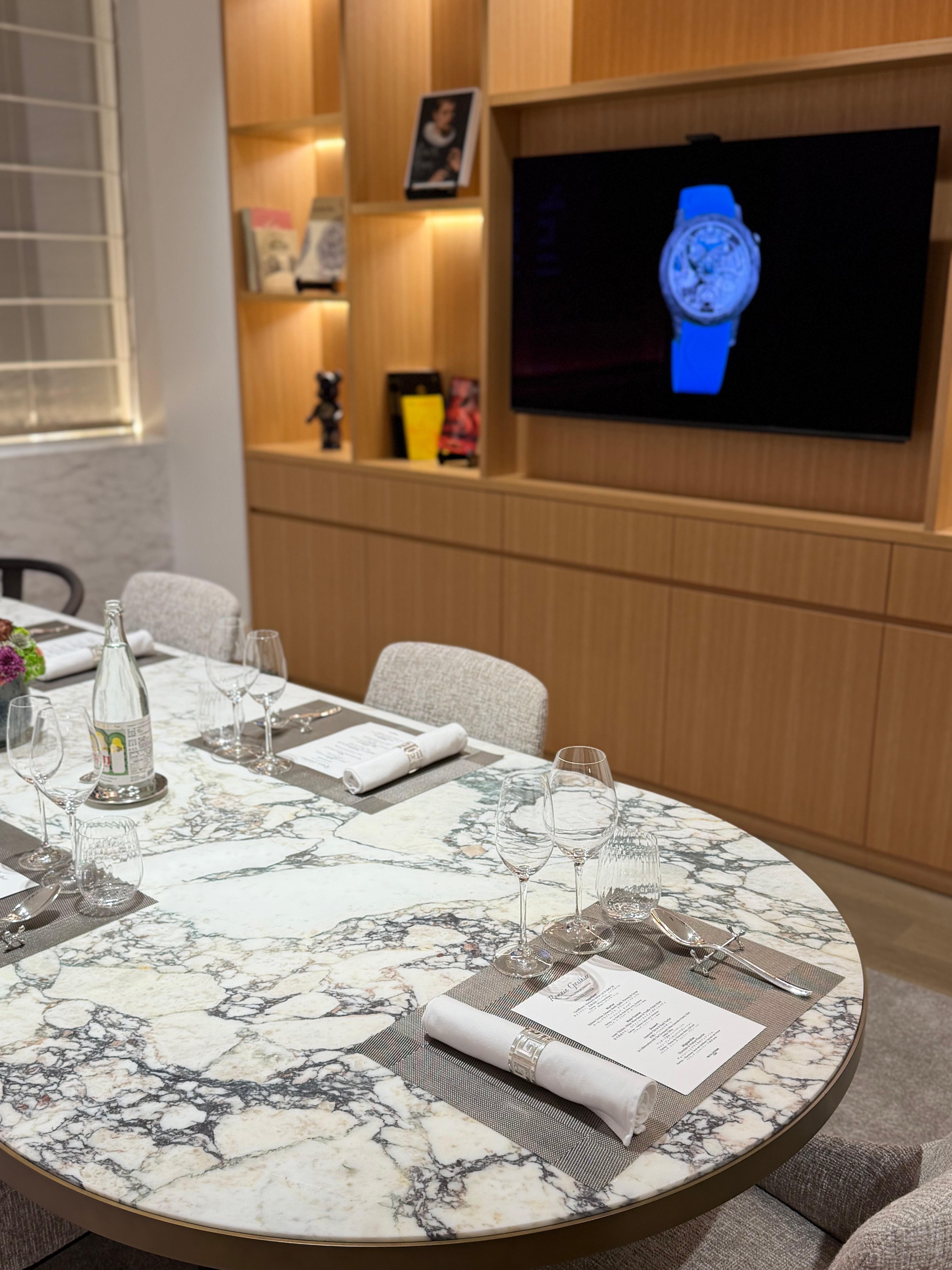
One particularly notable example involved Swiss watchmaker Romain Gauthier during the opening of the brand’s first-ever global flagship salon inside Nisshindo Ginza.
Founded in 1892, Nisshindo remains one of Japan’s most historic luxury watch retailers, making the project especially significant within the world of haute horlogerie.
For the opening, Tokyo Catering Club designed and executed bespoke six-course private dinners with wine and sake pairing directly inside the boutique itself.
The challenge extended far beyond gastronomy alone.
The venue had no production kitchen on site. The dinners took place inside an active luxury retail environment in Ginza and required an extremely discreet operational approach. Every aspect — timing, plating, service flow, logistics and pairing execution — needed to feel effortless while respecting the atmosphere associated with Swiss high watchmaking.
Tokyo Catering Club created a fully custom gastronomic experience combining French culinary techniques with Japanese ingredients and presentation sensibilities in order to reflect both the Swiss identity of Romain Gauthier and the Tokyo context surrounding the launch.
The result was a temporary fine dining environment built entirely inside a space never originally intended for gastronomic hospitality.
This ability to adapt hospitality concepts to highly constrained luxury environments has also become increasingly important within Tokyo’s automotive sector.
In one recent VVIP lunch reception organized inside a Rolls-Royce showroom in Tokyo, the challenge again involved transforming a non-hospitality venue into a refined guest experience despite the absence of any production kitchen on site.
Tokyo Catering Club developed custom cocktails specifically for the event while managing the full hospitality operation throughout the day, including staffing, equipment logistics, beverage coordination and discreet setup management.
Within luxury automotive environments, hospitality cannot dominate the space. It needs to integrate naturally into the brand atmosphere itself — elegant, fluid and almost invisible operationally.
The company has also progressively developed strong expertise operating inside highly unconventional venues across Tokyo.
For a full-day activation organized for UGG inside a temple environment, teams needed to be operational before 7:00 AM while simultaneously managing multiple dietary restrictions, venue limitations and branded hospitality installations.
Alongside breakfast, lunch and refreshments throughout the day, the project included a custom UGG-branded La Marzocco espresso station designed as part of the guest experience itself.
Because the venue had not been designed for hospitality production, the operation required temporary infrastructure, carefully coordinated logistics and highly controlled setup procedures.
Projects of this nature increasingly reflect how hospitality for luxury and lifestyle brands is evolving in Tokyo.
Food and beverage are no longer treated as secondary event services. They now function as part of the overall brand narrative and guest experience.
This evolution is equally visible within the corporate world.
For many international companies operating in Tokyo, organizing restaurant experiences for large executive teams quickly becomes impractical due to transportation, scheduling and group coordination constraints.
As a result, many corporations increasingly seek to transform their own office spaces into temporary hospitality environments capable of delivering experiences comparable to premium restaurants while remaining compatible with active business operations.
Tokyo Catering Club has progressively supported several multi-day workplace hospitality programs for international teams operating between Japan and overseas offices.
Rather than relying on traditional buffets, these projects focused on creating dynamic and social food experiences directly inside the workplace through rotating live stations and changing concepts throughout the week — including izakaya-style hospitality, ramen stations, sushi counters, taco activations, cocktails and wagyu carving experiences.
The objective was not simply to provide meals, but to create relaxed, high-quality hospitality moments capable of bringing energy and interaction into the corporate environment itself.
Executing these operations inside active office buildings requires a level of precision that is often underestimated from outside Japan.
In Tokyo, successful hospitality depends not only on cuisine or presentation, but also on everything guests never see: logistics, timing, staffing, communication, contingency planning and the ability to adapt calmly to highly constrained environments.
This operational discipline is one of the reasons Tokyo Catering Club has progressively become a preferred hospitality partner for luxury brands, embassies and global corporations operating in Japan.
Making complexity feel effortless is precisely what defines premium hospitality at the highest level — and what Tokyo Catering Club delivers across Tokyo, project after project.
For inquiries: contact@tokyocateringclub.com
Leave a Reply